UK School System
Through PT Education Pathways, international students have the opportunity to experience life as a student in a British state school through our High School Programmes. Our programmes provide students with the opportunity to experience the UK education system, develop their English language skills and gain a genuine insight into British culture and everyday life. Depending on the programme selected, students can join a UK school for a short-term immersion experience of between 1 and 7 weeks, or participate in a longer-term High School Programme, studying alongside British students for a term or semester.
Students attend lessons within their appropriate year group and participate in normal school activities, giving them the opportunity to experience education in an authentic British environment. They are encouraged to build friendships, develop independence, increase their confidence and use English naturally throughout their daily lives. For students participating in a High School Programme, the experience goes beyond the classroom. Living with a carefully selected UK host family provides students with a genuine home-from-home environment and the opportunity to experience British family life, traditions and culture. Students become part of their local community while developing valuable intercultural understanding and independence.
Short-Term High School Immersion Programmes offer a more flexible introduction to British education and are particularly suitable for students who want to experience studying in the UK without committing to a longer placement. For many students, a short stay can provide the confidence and experience needed to consider future study opportunities in the UK or other English-speaking countries.
Both programme options can become a valuable springboard towards future educational and career aspirations. Students may use their experience to strengthen their English communication skills, prepare for future international study and develop the confidence required to operate successfully in an increasingly global environment. Whether a student joins us for a few weeks, a school term or a semester, our aim is to provide an educational experience that combines academic development, cultural understanding, personal growth and student welfare.
key stages
Students attending UK state schools are organised into groups known as Key Stages, which form part of the structure of the English National Curriculum. Students are generally placed according to their age and previous educational experience, ensuring that they join an appropriate year group and can participate fully in school life.
The Key Stage structure helps parents and students understand how the UK education system is organised and where a student is likely to be placed during their High School or Short-Term High School Immersion Programme.
The table on the next page provides an overview of the UK Key Stages, school years and typical student ages, together with the corresponding stages of education.

Lower Schools
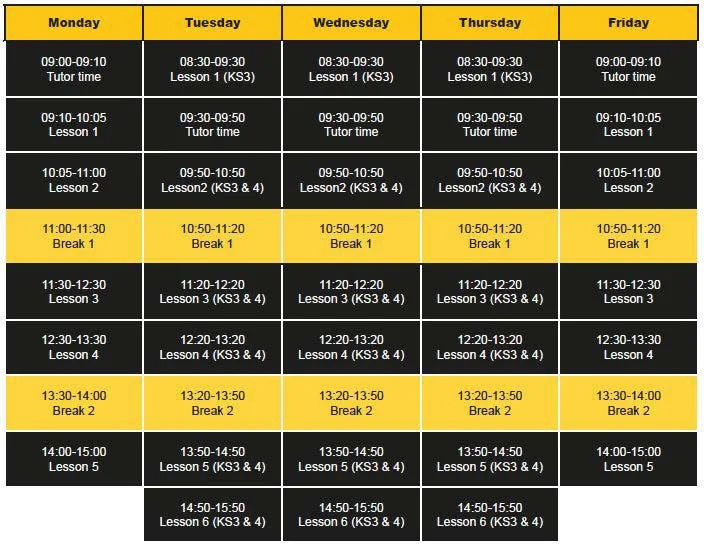
Students aged 11 to 16 have the opportunity to attend a British state school and experience life as a local student within the UK education system. During their placement, students join mainstream classes alongside British pupils, allowing them to experience the academic, cultural and social aspects of everyday school life.
The National Curriculum provides a structured framework of subjects and learning objectives followed by state schools across England. It is designed to ensure that students receive a broad and balanced education, developing their knowledge, skills and understanding throughout their primary and secondary education.
As part of their school experience, international students may study a range of subjects including English, Mathematics, Science, History, Geography, Modern Foreign Languages, Physical Education, Art, Design and Technology, Computing and other subjects offered by their host school.
sample timetable
Sixth Form
The UK education system is respected worldwide, and A Levels are recognised by universities internationally. Sixth Form or College, comprising Years 12 and 13, is the final stage of secondary education before university.
Students normally begin Sixth Form at the age of 16 and specialise in three or four subjects based on their academic strengths, interests and future career ambitions. Unlike earlier years, there are no universally compulsory subjects, allowing students to follow a more personalised programme.
The depth and level of study in Year 13 provides strong preparation for university, with students developing advanced subject knowledge, critical thinking, analytical skills and independent learning.
BTEC and CTEC qualifications provide an alternative, more practical approach to learning. They are coursework-based, focus on real-world applications and can be studied independently or alongside A Levels, depending on the school or college.
how does sixth form work?
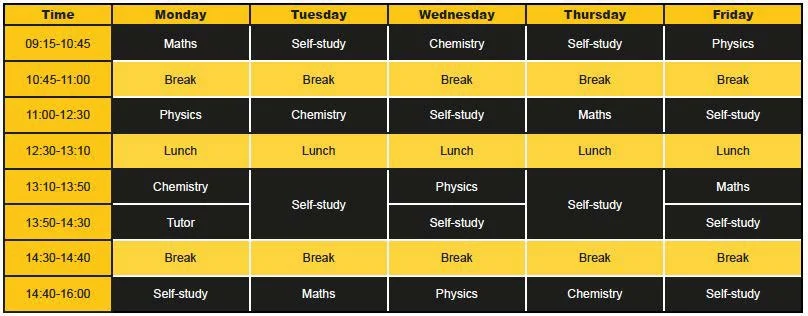
Students have a combination of classroom teaching and independent study, typically receiving around 4.5–5 hours of classroom tuition per subject each week. Their timetable will normally include dedicated periods for self-study, which students are expected to use productively at school, in the library or at home.
Sixth Form encourages students to take greater responsibility for their learning and develop the independence required for university and future employment.
For international students, PT Education Pathways can discuss opportunities with British State schools to include an additional subject or extracurricular activity where appropriate. However, school timetables generally accommodate three or four subjects, subject to class sizes, staffing and availability.
sample timetable